
Pakistan, Turkiye, and Saudi Arabia have signed a trilateral defence pact, agreeing to treat an attack on one as an attack on all. Analysts suggest this alliance could significantly diminish the United States' strategic influence in West Asia and elevate Pakistan's geopolitical standing, potentially acting as a deterrent in regional conflicts.

The ministry of external affairs on Friday dismissed as 'fake news' reports alleging that India had requested Israel to sign a defence pact in response to the newly formed Pakistan-Saudi Arabia-Turkey security framework.

Pakistan, Saudi Arabia and Turkiye on Friday signed a key joint defence agreement under which an attack against one of them will be treated as an attack against all of them, amid increasing security concerns in the wake of escalating tensions in West Asia.
Any military response to a cross-border terror attack from Pakistan will have to take into account the new alignments beginning to take shape in the region, points out former foreign secretary Shyam Saran.
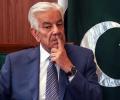
Pakistan's Defence Minister Khawaja Asif has reiterated the nation's unwavering commitment to the Makkah Joint Defence Agreement, underscoring its role in regional security following an attempted drone attack near the holy city of Mecca. The pact, signed by Pakistan, Turkiye, and Saudi Arabia, establishes a framework for collective deterrence against armed attacks.

Pakistan's Defence Minister Khawaja Asif has issued a stern warning that the Makkah Defence Alliance, a newly formed pact between Pakistan, Saudi Arabia, and Turkiye, stands ready to activate its collective defence provisions in response to escalating Houthi attacks on Saudi Arabia.

Bangladesh is considering joining a newly formed defence alliance between Saudi Arabia, Pakistan, and Turkiye, with junior ministers stating that any decision would be based on national interests and a "Bangladesh First" policy. The pact, signed in Makkah, aims for collective deterrence.

A question has been raised whether the Mecca Pact will have a negative impact on our doctrine that the Operation Sindoor has only been suspended and that it would be resumed if Pakistan engages in terrorism in the future. But the Mecca Pact only speaks of aggression, not defence against terrorism, points out Ambassador T P Sreenivasan.

Under the defence partnership, India and the UAE are eyeing defence industrial collaboration and cooperation in advanced technologies, cyberspace training, special operations, interoperability of their militaries and counter terrorism.

Amidst escalating tensions in West Asia, Pakistan's defence chief visited Saudi Arabia to discuss regional security and the mutual defence pact between the two nations, focusing on de-escalation strategies.

US Vice President JD Vance and Prime Minister Narendra Modi held a phone call to discuss expanding the India-US comprehensive global strategic partnership, focusing on trade, defence, energy security, emerging technologies, and critical minerals. The discussion comes amidst rising tensions in West Asia and recent regional realignments, with both leaders reaffirming their commitment to strengthening cooperation.
'It beggars belief that Saudi Arabia would deploy military force against India, a top partner and market.'
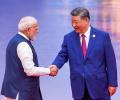
Ahead of Xi Jinping's visit, National Security Advisor Ajit Doval and Chinese Foreign Minister Wang Yi held extensive talks in Beijing on August 25 on the boundary issue and reached an eight-point consensus.

Experts believe it would be far-fetched to believe that Riyadh would support Pakistan militarily in any conflict with India, which has robust strategic and economic relations with Saudi Arabia.


'The White House lunch that Trump hosted for Munir last year came just after Munir returned from a visit to Iran, at a moment when Israel and Iran were at war.' 'Trump said after that lunch that the Pakistanis know Iran very well. He likely views Munir as a useful interlocutor that can give helpful insights on Iran.'

Iran was the chance to arrange a concert of nations, to actually be a Vishwaguru. Instead, we are watching from the sidelines as Pakistan, the same country that is apparently still at war with Afghanistan, hosts talks between US-Israel and Iran. The irony is hard to miss, points out Amberish K Diwanji.
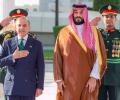
Prime Minister Shehbaz Sharif met with Saudi Crown Prince Mohammed bin Salman to express Pakistan's support for the Kingdom amidst escalating tensions in West Asia, reaffirming their mutual defence pact and commitment to regional stability.

India has expressed its expectations for Saudi Arabia to consider 'mutual interests and sensitivities' in their bilateral strategic partnership, following Riyadh's strategic defence pact with Pakistan.

'In a volatile global market, India is pursuing a low-risk, low-return policy, akin to a SIP -- slow, steady investment.' 'Pakistan is following a high-risk, high-return policy.'

Pakistan has deployed a military contingent, including soldiers and fighter jets, to Saudi Arabia as part of a joint strategic defence agreement aimed at enhancing military coordination and regional security.

'We caught General Pervez Musharraf talking over the phone with his Chief of General Staff Lieutenant General Mohammad Aziz. Musharraf was visiting China; Aziz was in Rawalpindi.'
The entry of other Arab countries in the mutual defence deal between Pakistan and Saudi Arabia is not ruled out, Defence Minister Khawaja Asif has said, adding that 'doors are not closed' for such developments.

The United States' historical strategic alignment with Pakistan, dating back to the Cold War, has consistently aimed to create a political and military parity with India, despite India's significantly larger size and resources. This long-standing relationship continues to influence regional dynamics, particularly in West Asia and the Indo-Pacific.
'Saudi-Pak defence pact is to anchor the defence and security of Saudi Arabia and not Pakistan, per se, with Islamabad being the junior partner.'

'Pakistan has found itself in a favourable position after Operation Sindoor by appreciating the mediation as claimed by Trump and recommending him for the Nobel Peace Prize.'

Prime Minister Narendra Modi and US President Donald Trump are set to hold comprehensive talks focusing on a bilateral trade deal, defence cooperation, and energy and critical minerals sectors during the G7 summit in Evian-les-Bains, France.

Prime Minister Narendra Modi and US President Donald Trump exchanged pleasantries and held a brief conversation at the G7 summit, their first in-person encounter in 16 months, setting the stage for high-stakes bilateral talks amidst continuing strain in India-US relations.

In a statement issued following the announcement of the US-mediated deal, Qassem characterised the agreement as a 'humiliating' and 'shameful' surrender of Lebanese sovereignty that prioritises Israeli and American dictates over the nation's independence.
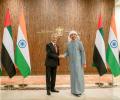
Frankly, was it really necessary in the middle of a fratricidal war for External Affairs Minister S Jaishankar to travel to Abu Dhabi for a one-on-one with the sheikh on April 12?Or, for National Security Advisor Ajit Doval to follow up on April 26? Or, for PM Narendra Modi to follow through today? There are no easy answers, notes Ambassador M K Bhadrakumar.

India and Pakistan exchanged lists of nuclear installations and prisoners, continuing a long-standing practice despite strained relations.

'What we need to watch is how Saudi Arabia's financial assistance will be used by Pakistan. If the funds go to build their military hardware and operations, it should worry us.'

'Nor would it have serious implications in India's relations with Saudi Arabia that stand on their own and have improved significantly in recent times, including in defence and strategic affairs.'

Swaraj expressed satisfaction over the agenda of the inaugural dialogue while giving the details of the deliberations.

Saudi Arabia and Pakistan have signed a 'Strategic Mutual Defence Agreement', pledging that any aggression against either nation would be treated as an attack on both.

The delegations from the US and Iran head to Islamabad on Friday, carrying a ceasefire that is already fraying, a Strait that is technically open and practically closed, and a negotiating agenda that would challenge even parties actually negotiating in good faith, which these groups are not. Prem Panicker continues his must read blog on the Iran War.
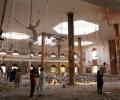
In 2025, India launched Operation Sindoor, a multi-domain combat mission against Pakistan in response to cross-border terrorism. The operation involved precision strikes, military retaliation, and diplomatic measures, marking a significant shift in India's security policy.
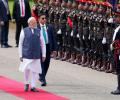
India's concerns over a planned naval exercise between Pakistan and Sri Lanka in the strategically important waters of Trincomalee led to the shelving of the drills weeks ago. The exercise was planned as part of regular engagements between the two navies, but India expressed its apprehensions to the Sri Lankan government. Trincomalee, situated on Sri Lanka's northeastern coast, is considered a significant hub in the Indian Ocean region, particularly for India's maritime security interests. The Pakistani Navy's close cooperation with China's PLA Navy has raised concerns in New Delhi about any Pakistani warship presence in Trincomalee. This incident follows previous diplomatic rows between India and Sri Lanka over the docking of Chinese vessels at Sri Lankan ports. India has been actively supporting Sri Lanka's development of Trincomalee's energy infrastructure and has recently signed a defense pact with the country to boost military cooperation.
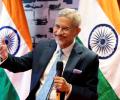
'The logic every one of our neighbours must realise is that working with India will give you benefits, and not working with India has a cost.'
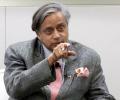
"China is an absolutely impossible factor to ignore in what has been our confrontation with Pakistan," Tharoor said.
